

How to Measure for a Canopy Replacement Cover
Posted by CanopiesAndTarps on Jul 27th 2026
Learn which frame measurements, roof details, attachment features, and compatibility information you need before ordering a replacement canopy cover.
Not sure what size canopy replacement cover you need? The most reliable approach is to measure the canopy frame rather than the old fabric. Canopy covers may stretch, shrink, sag, or become distorted after years of outdoor exposure, making the old cover an unreliable sizing reference.
Width and length are important, but they are not the only measurements that determine whether a replacement cover will fit. Roof style, peak dimensions, frame diameter, valance design, attachment method, and manufacturer compatibility can all affect the final fit.
Shop Replacement Canopy CoversWhat You Need Before Measuring
Measuring Tape
Use a tape measure long enough to measure the full width, length, height, and roof slope of the frame.
Step Ladder
A stable ladder may be required to reach the roof peak, rafters, and upper frame connections safely.
Notebook or Phone
Record every measurement and take clear photos of the roof shape, frame fittings, labels, and attachment points.
Second Person
Larger frames are easier and safer to measure with another person holding the opposite end of the tape.
Measurements and Details You Should Record
Frame Width
Measure from the outside edge of one side of the frame to the outside edge of the opposite side.
Frame Length
Measure from the outside edge of the front frame member to the outside edge of the rear frame member.
Roof and Peak
Identify the roof shape and measure the peak rise or sloped roof section as required.
Frame Diameter
Measure the outside diameter of the tubing rather than relying only on a stated trade size.
Valance Style
Determine whether the existing frame uses a straight roof cover or a cover with a hanging valance.
Attachment Method
Record whether the cover attaches with ball bungees, straps, ratchets, pockets, hook-and-loop tabs, or another system.
Step-by-Step: How to Measure Your Canopy Frame
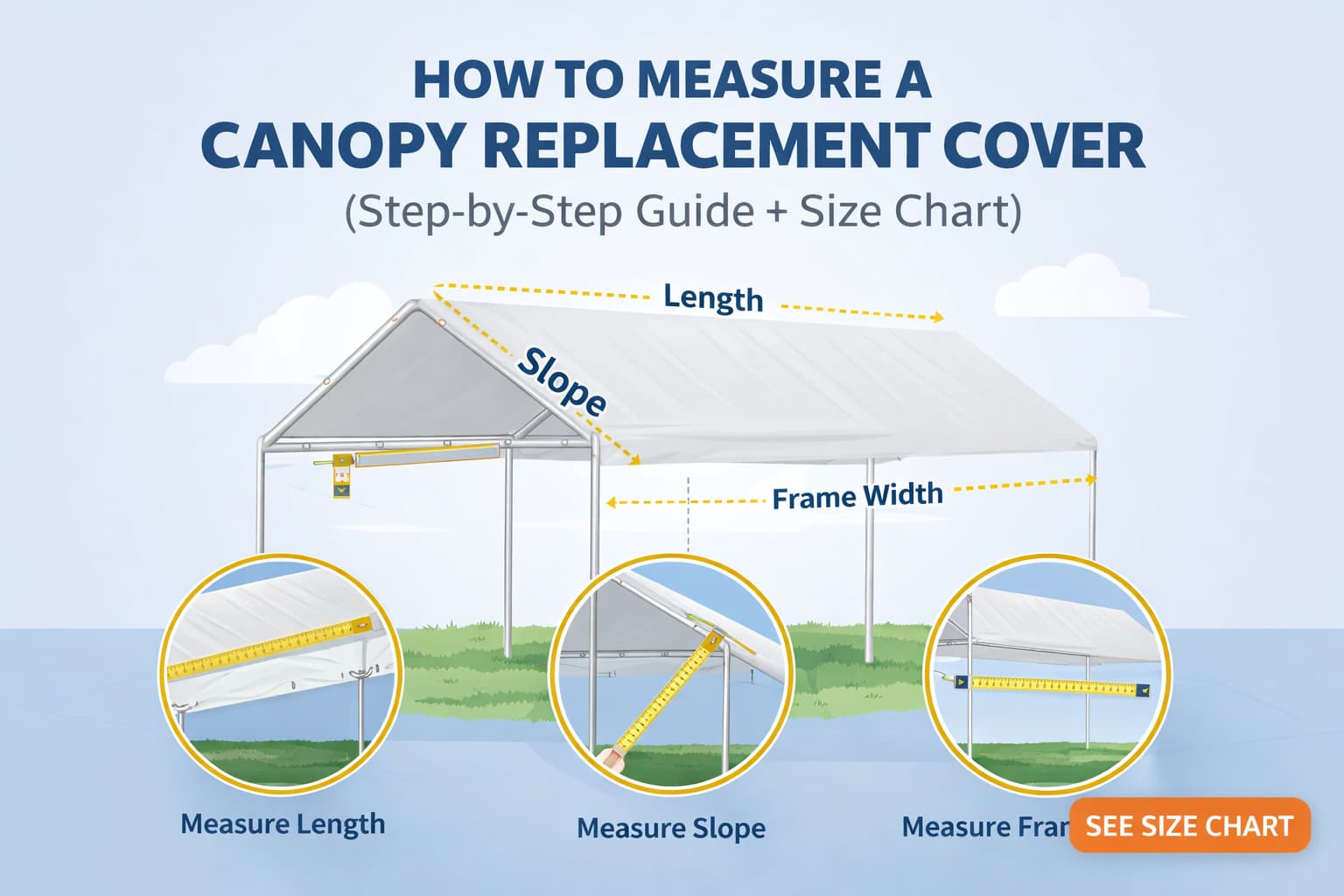
Measure the Overall Frame Width
Measure horizontally across the short side of the canopy from the outside edge of one frame leg or side rail to the outside edge of the opposite side.
Do not measure only the open space between the legs. Replacement cover dimensions are generally based on the overall frame footprint.
Measure the Overall Frame Length
Measure from the outside edge of the front portion of the frame to the outside edge of the rear portion. Keep the measuring tape straight and level.
On longer canopies, measure both sides of the frame. Differences may indicate that the structure is not square or that sections have shifted.
Identify the Roof Style
Determine whether the canopy has a high-peak, low-peak, flat, round, barn-style, or other roof configuration. Two frames with the same width and length may require completely different covers when their roof shapes differ.
Pay close attention to the angle of the roof fittings and the number and arrangement of rafters.
Measure the Peak Rise or Roof Slope
For a peaked frame, measure vertically from the top of the side rail to the highest point of the roof. This is the peak rise.
You may also need to measure along the sloped roofline from the center peak to the outside edge where the cover attaches.
Measure the Frame Tubing Diameter
Measure straight across the outside of the tubing at the widest point. Common canopy tubing sizes include approximately 1-3/8 inches, 1-5/8 inches, and larger commercial diameters, but the actual frame should always be checked.
Frame diameter can affect how the cover wraps around the structure and where the attachment points align.
Check the Valance and Side Drop
A valance is the section of material that hangs below the roof edge. If the replacement cover includes a valance, record its approximate depth and confirm whether it is designed to cover only the roof or extend down over the side rails.
A valance cover and a non-valance cover are not automatically interchangeable, even when the frame dimensions appear similar.
Document the Attachment System
Look underneath the roof edge and record how the cover connects to the frame. Common systems include grommets with ball bungees, webbing straps, ratchet straps, elastic cords, fabric pockets, sleeves, and hook-and-loop fasteners.
Count the approximate number of attachment points and note their placement whenever possible.
Look for Brand, Model, or Part Information
Check the frame, fittings, old cover, instruction manual, storage bag, or original invoice for a manufacturer name, model number, serial number, or replacement part number.
Model information can be essential for portable garages and branded shelters because many replacement covers are designed for one specific frame.
Take Clear Photos
Photograph the full front, side, roof profile, corner fittings, peak fittings, attachment points, doors, labels, and any unusual frame features.
Photos can help identify details that measurements alone may not reveal.
Canopy Measurement Worksheet
Record the following information before comparing your frame with a replacement cover:
Common Canopy Sizes
The sizes below are common reference sizes only. A stated size such as 10 feet by 20 feet does not guarantee compatibility between a frame and replacement cover.
| Nominal Frame Size | Common Applications | Important Fit Details to Confirm |
|---|---|---|
| 10' × 10' | Small patio, vendor area, equipment shade, or compact storage | Roof angle, frame type, valance, and attachment pattern |
| 10' × 20' | Vehicle coverage, storage, work area, or event use | Peak style, tubing diameter, finished cover dimensions, and number of legs |
| 12' × 20' | Carport, boat shelter, equipment storage, or work area | Center height, roof slope, attachment system, and manufacturer compatibility |
| 18' × 20' | Large vehicle, commercial storage, equipment, or material protection | High-peak or low-peak design, tubing size, valance, and reinforcement layout |
| 20' × 20' | Large storage, work areas, events, or commercial coverage | Roof configuration, center poles or rafters, frame diameter, and attachment spacing |
Nominal Size vs. Finished Cover Size
Canopies are commonly described by a nominal frame size, such as 10 feet by 20 feet. The actual replacement cover may be manufactured slightly smaller or differently shaped so that it can be properly tensioned over the frame.
Do not assume that a cover labeled 10 feet by 20 feet will measure exactly 10 feet by 20 feet when laid flat. Always compare your frame measurements with the product's stated finished dimensions, roof design, and compatibility information.
Replacement Covers Are Not Automatically Universal
A cover may have the same advertised width and length as your frame and still be incompatible. Differences in roof angle, peak height, tubing diameter, leg placement, valance design, door configuration, and attachment points can prevent a proper fit.
When a product is described as model-specific, use it only with the frame models listed by the manufacturer or seller.
Universal vs. Brand-Specific Replacement Covers
Universal-Style Covers
These covers are intended to fit a range of compatible frames, but the width, length, roof profile, frame diameter, and attachment method must still match.
Brand-Specific Covers
These are manufactured for particular shelter models and often include model-specific pockets, doors, ratchets, fasteners, or panel dimensions.
Unknown Frames
When the manufacturer is unknown, collect detailed measurements and photos before selecting a replacement. A matching nominal size alone is not enough.
Common Measuring Mistakes to Avoid
Measuring the Old Fabric
Weathered material can stretch, shrink, or become distorted. Measure the frame whenever possible.
Measuring Between the Legs
Interior clearance is not necessarily the same as the overall frame width or length.
Ignoring the Roof Shape
High-peak, low-peak, flat, barn-style, and rounded frames require differently shaped covers.
Skipping the Frame Diameter
Tubing diameter affects how the cover fits around the frame and where its fastening points align.
Assuming the Size Is Exact
Nominal dimensions and finished cover dimensions may differ because covers are designed to tension over the structure.
Overlooking Attachment Points
A correctly sized cover may still be unusable if its grommets, straps, pockets, or ratchets do not match the frame.
Ignoring Valance Design
A valance cover may have different finished dimensions and attachment requirements than a standard roof-only cover.
Relying Only on a Product Photo
Similar-looking shelters can use very different frames and covers. Compare the written specifications carefully.
How to Compare Your Measurements with a Product Listing
Once your measurements are complete, compare them with the replacement cover specifications one detail at a time:
- Overall compatible frame width and length
- Finished cover dimensions
- Roof shape and peak style
- Frame tubing diameter
- Valance or non-valance design
- Attachment method and spacing
- Door, zipper, or panel configuration
- Manufacturer and model compatibility
- Included hardware, straps, or fastening components
Do not order solely because the product title contains the same nominal size as your frame. Read the complete product description and compatibility notes before purchasing.
Helpful Replacement Cover Resources
Use these guides and tools to compare cover styles, identify compatible models, and find the best option for your frame.
- How to Choose a Replacement Canopy Cover Compare frame size, roof style, material, fit, and environmental requirements.
- High-Peak vs. Traditional Canopy Replacement Covers Learn why the same frame footprint may require a different cover based on roof configuration.
- Valance vs. Non-Valance Canopy Covers Compare roof-only covers with styles that extend below the roof edge.
- Universal vs. Brand-Specific Replacement Covers Understand the differences between general-fit options and model-specific covers.
- How to Find the Right ShelterLogic Replacement Cover Step-by-step help identifying a model-specific ShelterLogic replacement cover.
- Shop Canopy Replacement Covers Browse replacement covers for canopies, carports, shelters, and portable garages.
- Explore Canopy Enclosures and Kits Add side panels, doors, and enclosure components to compatible canopy systems.
- Use the Tarp and Canopy Product Selector Get guided help identifying a canopy, tarp, shelter, or replacement cover option.
Frequently Asked Questions
Should I measure the old canopy fabric or the frame?
Measure the frame whenever possible. Old canopy fabric may stretch, shrink, sag, or lose its original shape after outdoor exposure, making it unreliable for replacement sizing.
What measurements do I need for a replacement canopy cover?
Record the overall frame width and length, side height, center height, peak rise or roof slope, tubing diameter, roof style, valance design, and attachment method. Manufacturer and model information should also be recorded when available.
How do I measure canopy width and length?
Measure from outside edge to outside edge of the frame. Do not measure only the interior opening or the distance between the inside edges of the legs.
How do I measure the roof peak?
Measure vertically from the top of the side rail to the highest point of the roof to determine the peak rise. You may also need the sloped measurement from the center peak to the roof edge.
How do I measure the frame tubing diameter?
Measure straight across the outside of the tubing at its widest point. Do not wrap the measuring tape around the pipe unless you plan to calculate the diameter from its circumference.
Will any cover with the same width and length fit my canopy?
No. Roof angle, peak height, tubing diameter, valance style, frame configuration, attachment method, and manufacturer design can all affect compatibility.
What is the difference between nominal and finished cover size?
Nominal size generally describes the frame footprint, while finished size refers to the actual manufactured dimensions of the cover. A replacement cover may be slightly smaller or differently shaped so it can tension correctly over the frame.
What happens if a replacement cover is too large?
An oversized cover may sag, flap in the wind, rub against the frame, collect water, and place uneven stress on its grommets or attachment points.
What happens if a replacement cover is too small?
A cover that is too small may not reach the attachment points, may be difficult or impossible to install, and may be placed under excessive tension.
How can I identify an unknown canopy frame?
Look for labels, part numbers, receipts, manuals, or markings on the frame and old cover. Record detailed measurements and take photos of the full structure, roof profile, fittings, doors, and attachment system.
Find the Right Replacement Canopy Cover
Accurate measurements are the first step, but compatibility also depends on roof style, frame diameter, valance design, attachment method, and manufacturer specifications. Compare every detail before selecting a replacement.
Replacement cover suitability depends on the complete frame design and product specifications. Matching nominal width and length alone does not guarantee compatibility.