

Valance vs Non-Valance Canopy Covers (Complete Guide)
Posted by CanopiesAndTarps on May 18th 2026
When replacing a canopy cover, one of the most important design differences to understand is valance vs non-valance canopy styles. While both cover types provide weather protection, they differ in appearance, fitment, frame compatibility, and edge design.
This guide explains the differences between valance and traditional non-valance canopy covers and helps determine which replacement cover style is compatible with your canopy frame.
What Is a Valance Canopy Cover?
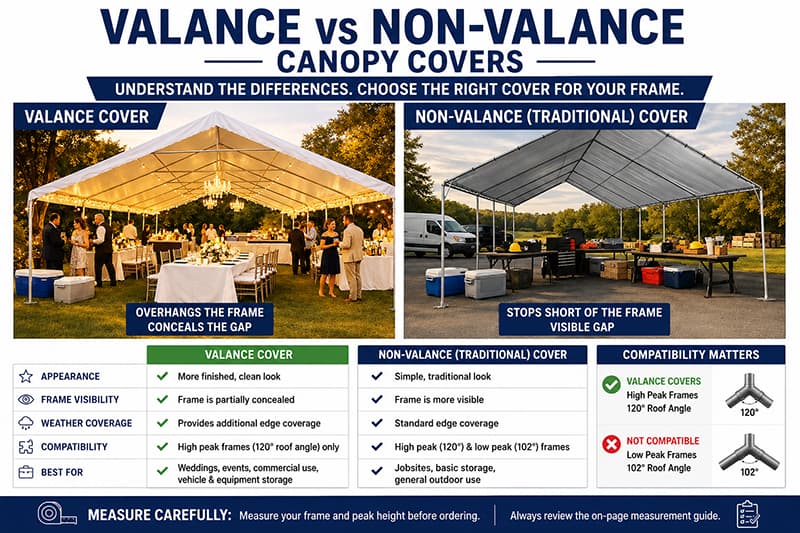
A valance canopy cover includes additional fabric that hangs down over the outer edge of the canopy frame. This overhang is commonly referred to as the “valance edge.”
Valance covers provide:
- A cleaner finished appearance
- Additional edge coverage
- Reduced visibility of the frame tubing
- Improved rain runoff near the canopy edge
Valance covers are commonly used for:
- Commercial canopy tents
- Event canopies
- Vehicle shelters
- Outdoor storage canopies
What Is a Non-Valance (Traditional) Canopy Cover?
Traditional non-valance canopy covers do not include an overhanging edge. Instead, the cover attaches directly to the canopy frame and typically stops short of the outer frame edge.
This creates a small visible gap between the edge of the tarp and the frame tubing once installed.
Traditional covers are commonly chosen for:
- Basic outdoor shelters
- Jobsite canopies
- Temporary storage structures
- Standard canopy applications
Visual Differences Between Valance & Traditional Covers
| Feature | Valance Cover | Traditional Cover |
|---|---|---|
| Edge Design | Overhanging valance edge | Straight edge |
| Frame Visibility | Frame partially concealed | Frame more visible |
| Appearance | More finished look | Simpler utility style |
| Compatibility | High peak frames only | High peak & low peak frames |
Frame Compatibility Matters
One of the most important differences between these cover styles is frame compatibility.
Valance canopy covers are designed specifically for high peak canopy frames using 120-degree roof angles.
Low peak canopy frames use 102-degree angled fittings and cannot properly accommodate valance replacement covers due to differences in roof geometry and fabric dimensions.
Traditional non-valance covers can typically be used on both high peak and low peak canopy frames depending on the frame measurements and design.
Why Roof Angle Affects Cover Fitment
Canopy covers are designed around specific frame dimensions, roof angles, and peak heights.
Changing the roof pitch changes:
- The amount of material required
- The canopy peak height
- The edge drop dimensions
- The overall fitment geometry
This is why replacement canopy covers are not considered universal fit.
Common Customer Mistakes
- Ordering a valance cover for a low peak frame
- Assuming all 10' x 20' canopies use the same cover style
- Ignoring roof angle differences
- Ordering based only on footprint dimensions
- Not reviewing the on-page measurement guide before ordering
How to Identify Your Canopy Style
To determine whether your frame uses a valance or traditional cover:
- Check whether the existing cover hangs over the frame edge
- Measure the roof peak height
- Identify whether the frame uses 102° or 120° fittings
- Review the canopy frame design and measurements
Customers are encouraged to carefully review all product measurement guides before ordering replacement covers.
Shop Replacement Covers
- Valance Replacement Covers
- Traditional Replacement Covers
- High Peak Replacement Covers
- Vinyl Replacement Covers
Related Guides
Final Thoughts
Understanding the difference between valance and non-valance canopy covers is important for proper replacement cover fitment and compatibility.
Reviewing frame style, roof angle, and peak height before ordering can help ensure the correct replacement canopy cover for your structure.